Mangatangi–Maramarua Catchment
What began as a community response to a routine pest survey quickly became a mission to protect a globally unique species.
In the Mangatangi–Maramarua Catchment, initial monitoring revealed high numbers of rats, mustelids, and possums. The community moved swiftly, deploying over 940 bait stations across the landscape and synchronising seasonal re-baiting to ensure sustained pressure on pest populations. In areas that previously had little or no pest control, this coordinated effort means the catchment now has maximum coverage.
Then came the surprise: eDNA testing revealed the presence of Echyridella aucklandica, a rare native freshwater mussel found nowhere else in the world. Vulnerable and little-known, this ancient species gave new meaning to the mahi on the ground. The discovery underscored how pest control doesn’t just protect bush birds, but also the health of our waterways and the fragile species living within them.
What started as a pest control initiative has become something much larger: a catchment-ide commitment to guarding biodiversity, above and below the surface. Now, alongside Bait & Trap Days, school visits and community field trips, there’s a deeper narrative emerging, one of protecting not just the visible taonga like kākā and kererū, but also the hidden treasures of our streams and wetlands.
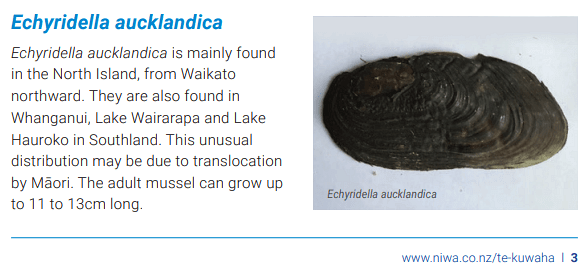
Echyridella aucklandica
Echyridella aucklandica is mainly found in the North Island, from Waikato northward. They are also found in Whanganui, Lake Wairarapa and Lake Hauroko in Southland. This unusual distribution may be due to translocation by Māori. The adult mussel can grow up to 11 to 13cm long.