From seed spreaders to busy parents, kererū play a vital role in our native bush
There is something hard to miss about a kererū.
Maybe it's the flash of white as one flies overhead, the unmistakable whoosh-whoosh of those big wings, or the rather spectacular thump they make when they land heavily in a tree.
But kererū are much more than a pretty face.
These big native pigeons play an important role in the health and regeneration of our forests — spreading seeds as they move through the landscape, feeding their young, and helping native plants find new places to grow.
And sometimes, they even leave clues behind about where they've been.
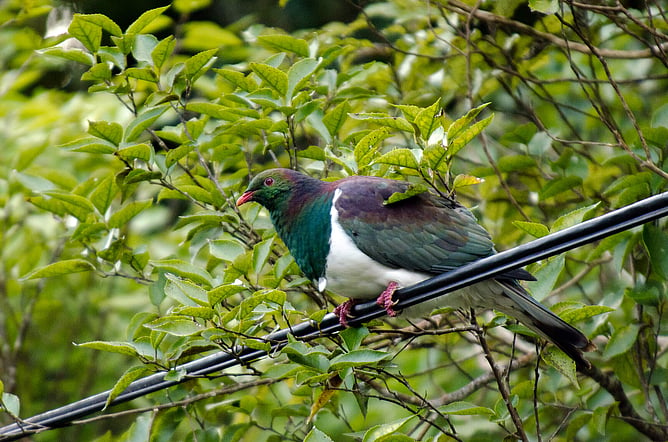
Look beneath a kererū's favourite tree
Some trees tell a story.
If you find a patch of taraire seedlings growing beneath a tree that has previously held a kererū nest, you may be looking at the leftovers of a very successful kererū dinner.
Kererū love fruit, and taraire is an important part of their diet. Taraire produces ripe fruit between around April and September, so finding taraire seedlings beneath a former nesting site can be a clue that the tree was being used by kererū during this period.
As kererū move from tree to tree, they swallow fruit and later deposit the seeds elsewhere.
And because kererū are large enough to swallow some of the bigger fruits and seeds produced by our native trees, they are particularly important seed spreaders.
In other words, when a kererū flies off after lunch, it may be carrying the beginnings of the next generation of native forest with it.
That makes every kererū more than just a bird in the landscape.
They're helping to plant the forest.
Although they aren't exactly fussy eaters...
Kererū don't limit themselves to native plants.
During late spring and summer, if woolly nightshade is growing nearby, they will happily tuck into its small, berry-like fruits.
Woolly nightshade belongs to the Solanum family — the same family as tomatoes — and its fruit can be particularly attractive to kererū.
It's a useful reminder that our native birds don't necessarily share our opinions about which plants belong in the garden!
For those of us working to regenerate our local environment, it also highlights the importance of looking at the whole picture. Healthy native habitat isn't just about planting more trees. It can also mean controlling invasive weeds and pests so that native plants have the best chance to thrive.
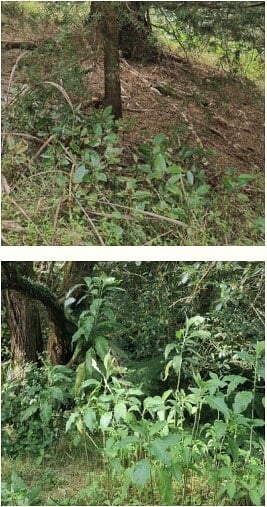
Patches of Tairere seedlings (above) and Woolly Nightshade (below) observed growing under previous Kererū nesting sites. Photos supplied by Andrew Sinclair
And then there are the babies...
Kererū have a surprisingly busy family life.
In our area, they generally lay one egg per nest, but when food is plentiful they can breed throughout the year.
A pair can even have two nests on the go at once — feeding a rapidly growing chick in one while incubating an egg in another.
The egg is incubated for around a month. Once the chick hatches, the parents remain closely associated with it for roughly another ten days.
After that, they become more like Uber Eats drivers than babysitters.
The adults fly in to deliver food before heading off again, returning regularly to keep their hungry youngster fed.
And remarkably, the young kererū can be fully fledged in around 35–40 days.
For a bird that starts life looking rather helpless, that's a pretty impressive transformation.
A changing menu
All that growing takes a lot of food.
For much of the year, kererū are busy dining on fruit. But around September and October, when the supply of berries and other fruit can start to dwindle, they change their menu.
Young leaves and buds become increasingly important.
This seasonal shift is another reason why a diverse landscape matters. A healthy mix of native trees and plants provides different food sources at different times of the year — helping birds find what they need as the seasons change.
And the more connected those food sources are, the easier it is for birds to move through the landscape.
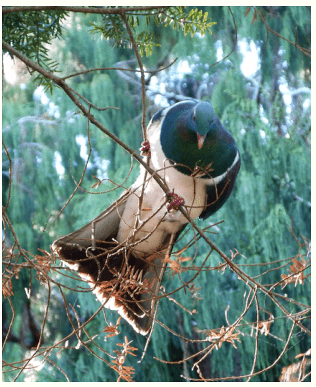
Kererū on watch. Photo: Amber Sims
So what does all of this have to do with predator control?
Quite a lot.
Kererū face a range of threats. Their eggs, chicks and adults can all be vulnerable to rats, possums, stoats and cats, while their nests can also attract attention from native predators such as kāhu.
At times, kāhu can even be seen hunting in pairs — with one bird higher above the canopy while another flies lower through the trees, disturbing potential prey.
Kererū nests can look surprisingly flimsy, and their chicks are remarkably well camouflaged. It is possible that these features provide some protection from predators hunting from above, although exactly how these characteristics evolved is difficult to know.
What we do know is that predation can have a significant impact on native birds, particularly when eggs and young chicks are involved.
That is why ongoing predator control matters.
When communities trap rats and mustelids, control possums and reduce the pressure from introduced predators, we give native birds a better chance of successfully raising their young.
And when that work is combined with protecting and regenerating habitat, the benefits can build over time.
The payoff is a landscape full of life
One of the most encouraging signs for anyone involved in community conservation is seeing more kererū around the neighbourhood.
Because when kererū become a regular sight, it can tell us something about the landscape they're living in.
There is food.
There are trees big enough to nest in.
There is habitat connecting one patch of vegetation to another.
And, hopefully, there are fewer predators making life difficult.
So when you see a kererū sitting high in a tree, feeding on fruit or gliding across your backyard, remember that you're looking at much more than a beautiful bird.
You're looking at a seed spreader.
A forest gardener.
A very busy parent.
And potentially, a sign that the work being done by communities to protect and regenerate our local environment is making a difference.
The next time a kererū lands in your backyard, take a moment to watch.
Because somewhere below that tree, there may already be a tiny taraire seed waiting for its chance to grow.
Inspired by...
This story was inspired by the work of Amber Sims from Whakaupoko Landcare.